Showing posts with label kimchi. Show all posts

Tuesday, November 12, 2013

156. Bay Area - Gathering for Bo Ssam at Namu Gaji (SF: Mission)

While waiting in line for Bi-Rite Creamery, have you ever peered in through the windows of the restaurant next door to see what those happy hipster looking people are eating? Well, near the windows it is likely that you will find an interesting array of Asian American fusion cuisine based on Korean roots, like a grass fed burger with kimchi relish or a bowl of handmade ramen with 4505 hot dogs.  At the communal table in the center of the restaurant you may find a crowd pleasing bo ssam pork belly dinner.  This is what Namu Gaji is known for.  The dinner feeds at least five hungry hippos with divinely crisp pork belly, raw oysters, fresh local vegetables, pickles, kimchi, and all the lettuce, cabbage, and sauce imaginable.  It is similar to the bo ssam dinner from David Chang's Momofuku Ssam Bar in New York, but unlike Momofuku, it doesn't take forever and a day to get a reservation for the meal.  And rather than just being a hip spot to meet up, Namu offers a nostalgia from the Lee brothers' childhood that gets transcended into the food. 


I gathered my friends from my study abroad program for a little catch up dinner in the city.  It has been five years since we left Shanghai, and it was time for a family style meal for us to share food and share updates on our lives.  Just like old times, Joyce suggested the restaurant, and I did the ordering.  Before we began our extravaganza of wrapping pork belly in various vegetables, we started with the Sichuan pepper chicken wings and the okonomiyaki.  The chicken wings wowed with its numbing peppery spice, and the okonomiyaki awed with its ever eerie dancing bonito shavings.  The Japanese quiche like pancake was more authentic than it was modern Asian, and I can appreciate that.  It was hot in temperature (it comes on a skillet) but warm in the emotion that it was served with.


The homeyness of the food on the menu was just enough to make my friends from Fudan feel comfortable and right at home, which made for an ideal spot to convene and connect.  Until the next gathering, let's all get S.O.F.A.T.

Namu Gaji
499 Dolores St. @ 18th St.
Mission District
San Francisco, CA 94110

ML - 20130903

Friday, April 5, 2013

Post 110: Collaboration with Whisks & Ruffles - Pork Belly, Part 2

In my previous post, I shared the first part of my collaboration with Angelina Ang Lee of Whisks & Ruffles.  This post will continue with more pork belly deliciousness.  Rather than braising this time, I grilled some thinner cuts of the pork belly.  And so continues the life of an inner fatty...


I used thin cuts of pork belly strips with beautiful fat on the trim.  The pork belly was marinated with a mixture of gochujang (Korean hot pepper paste), a bit of soy, sesame oil, chopped perilla (sesame seed leaves also known as shiso), and sesame seeds.  I added some ground black pepper too, but salt is not needed since the gochujang and soy sauce provide enough of that saltiness.


I faux grilled the pork belly using a Korean stone wok, which works great because it heats up quickly and retains the heat even after the stove is turned off.  The strips were cooked at medium-high heat.  The temperature must be hot enough for the fat to sizzle.  Must... hear... sizzle! Like... cooking bacon! Mmmmm... Flip the meat once only, and cook until it's brown and crisp on both sides.  If the heat is high enough, the meat will be fully cooked through because the cuts are not very thick.


Tiffany, my Chinese-American from Taiwan but also raised in Korea friend, came over for a taste test.  We ate the pork belly wrapped with fresh perilla leaves, raw sliced garlic, jalapeños, and diagonally cut scallions (see instructional clip by yours truly).  We also had sides of kimchi, yellow pickled daikon, and kimbap (Korean sushi or rice rolls) from the supermarket.  See Angelina's post on homemade kimbap to prepare your own.


I have been cutting down on some carbs lately, but the grilled pork belly would also work really well with steamed rice.  No worries, I could never cut carbs out entirely, but for now, meat and greens are good enough for me.  If the jalapeños aren't spicy enough for your taste, an extra dash of Sriracha hot sauce also helps add a spicy yet sweet flavor to your dish.  Or try Angelina's method, which is to add dried hot peppers... Indonesian style. 


Check out what Angelina came up with in the Lee kitchen using pork belly two ways.  Her double recipe storm includes a pork belly braised low and slow, which looks absolutely mouth watering.  Her second recipe is something that her mom used to make in Indonesia called babi kecap, a simmered stew of pork belly, tofu, and hard boiled eggs.  Ah, Mom's home cooking... my mouth is literally drooling right now...

Great job, Angelina.  I truly enjoyed our coast-to-coast collaboration.  Let's do it again soon! Until the next collaboration, let's all get S.O.F.A.T.

ML - 20130221

Thursday, March 15, 2012

Post 77: Fun Size Korean School Food (LA: Koreatown)

My roommate recently introduced me to School Food Blooming Roll, a restaurant that makes food that Korean students would typically bring in their lunch boxes to school.  This concept is quite unique, so I was eager to gather some friends for some famous Korean fare.  We ordered School Food's two most popular dishes, a super spicy tteokbukki and an epic platter of nine different kimbap. 


The rice cake typically used in tteokbukki are tubular and cylindrical, but School Food serves their version in a shape more similar to marshmallows, tater tots or fun size Snickers bars.  It's as if the restaurant purposely cut the size of the rice cake down so that elementary school children would enjoy their lunches more.  Who doesn't like miniature versions of everyday food?


The flavor profile is not just spicy but a melange of sweet and spicy together.  The thick, crimson sauce from the first taste of the tteok is sweet, but the peppery spice penetrates the taste buds soon after.  This wasn't the spiciest tteokbukki I've ever had, but it was pretty damn close to it.  We all know that gulp after gulp of water doesn't help, but I think that the spiciness led to a bit of temporary insanity because that's all I did to relieve the pain of the spice.  It wasn't until I munched on the kimbap and the accompanying sweet mayonnaise that my tongue calmed down and my ears stopped ringing.


Our massive platter included the following types of rice rolls: beef, garlic and bacon, anchovies, squid and squid ink, smelt roe, Spam, tuna, spicy anchovies, and kimchi.  And just like the tteok, the kimbap were bite sized too.  Korean style rice rolls are usually bigger than Japanese style sushi, so it takes more than one bite (depending on the size of your nom) to munch on the entire thing.  Luckily, these itty bitty kimbap were junior sized, which meant that popping a rice roll into your mouth didn't require much effort.  Hmm... is this the lesson we want to be teaching in schools?


My favorite kimbap were the ones that had tuna, Spam, and squid ink wrapped inside.  The tuna and Spam weren't anything out of the ordinary, but the saltiness of canned tuna and canned lunch meat really complemented the neutral flavor of the white rice well.  Japanese sushi relies heavily on the freshest raw fish to taste good, and since Korean kimbap focuses on ingredients other than raw fish, I found that the stronger the flavor, the more I ended up liking the kimbap.  


The squid ink kimbap, on the other hand, didn't quite have a strong flavor.  In fact, the squid was subtly sweet, and the flavor of its ink didn't really shine.  We all liked it just because the rice was black, and it seemed almost like a novelty food item.  It was unique, and we have the evolutionary bodily function of a certain cephalopod to thank for it.


After seeing the dishes, I could really imagine Korean school children carrying the fun size versions of tteokbukki and kimbap to class.  The food wasn't amazing delicious, but it was definitely fun to eat.  It was almost like revisiting the school cafeteria to have some of those nostalgic chicken nuggets, fish sticks... or for those of us from AUSD... crispitos! By the way, where can we find crispitos? Simply reminiscing about those school lunches from the good ol' days isn't going to cut it for me.  I'm going to need to munch on some real crispitos real soon.  But until then, let's all get S.O.F.A.T.

ML - 20120225

Friday, December 30, 2011

Post 73: 48 Hours of Seoul Food

I flew Asiana Airlines to Taipei this time, which called for a stopover at Incheon Airport on the way to/from LAX.  I took this opportunity to hop outside of Incheon Airport for a quick 48 hours to take a first glimpse at Seoul and spend some time with old schoolmates Rina and Myung who now live and work in Korea.  Here is a look at my 48 hour whirlwind in the capital city of South Korea.


My first bite of food in Korea (not counting the donuts I scarfed down at Incheon Airport) was from this harmonious plate of kimchi tofu.  Kimchi tofu is a type of anju, or Korean drinking snack, that pairs two major Korean staples together onto one plate.  When the tofu and kimchi meet in your mouth, the smooth, velvety, mild flavor of soft tofu engulfs the crunchy, tangy, spicy bite of stir-fried kimchi in a way that I can only parallel with my exhausted body collapsing into my pillows and comforters at the end of a long day.  Kimchi and tofu together makes as much sense as mashed potatoes and gravy, and it brings the same kind of soothing comfort to your soul.  I chased my first bite of dubu kimchi with a refreshing shot of Chamisul.  Ahhh... my first taste of Korea.


It didn't take long for the highly anticipated haemul pajeon to arrive.  This crackling seafood pancake is one of my favorite foods of all time, and to have the opportunity to enjoy it as part of my first meal in Seoul was just so insanely satisfying.  Various bits of seafood are mixed into the thinly grilled batter, which means that each piece varies from bite to bite.  The first bite might contain tender calamari... the next bite might contain a smidget of succulent shrimp... and the subsequent bite might contain clam meat or a jiggly octopus tentacle.  But no matter what sea creature you discover in your piece of pajeon, every bite contains a web of sliced green onion, which not only provides sweetness but holds the entire pajeon structure together.  Dipping it in a soy sauce mixture (sometimes simply called pajeon sauce) and then chasing it with more alcohol made the pancake taste better with every subsequent bite.


There was no way the meal was complete without more soju and tteokbukki (stir-fried rice cake).  But by this point in the meal, I wasn't sure if I was more drunk from the dozen shots of soju and many sips of makgeolli or from the cyclone of spiciness of the rice cake.  But to make certain it was the former and not the latter, we paid the bill and made our way through the streets of Seoul to a hof, a Korean style pub where the many more shots of soju confirmed that... yes, I was drunk from alcohol and not from spicy food.


In the midst of all this food talk, I have neglected to say that my newly assimilated Korean pal Rina had led me down some narrow, dark alley in Insadong for this first meal of various anju.  But a single file trek through an unfamiliar territory is just mind over matter if there is hope of good food and chilled soju at the end of it.  Dangle some seafood pancake at the end of a dark tunnel, and I can almost guarantee you that I'll walk down that path.


After a dozen blocks through Seoul's spirited streets and a couple of pit-stops at the batting cages and local arcade, we made our way up a few flights of stairs to the hof of choice.  Rows of wooden tables in dim lighting with second hand cigarette smoke drifting through the rafters, intermittent roars of laughter and high pitched feminine squeals broke the constant drone of K-pop over the restaurant's loudspeakers.  The most prominent noise that truly broke the muffled off-key karaoke was the clack of the soju glass as it was pounded on the wooden tables by hof's many night owls.  The feel was similar to the environment in Korean bars like Crazy Hook in LA or Min Sok Chon in San Diego.

The first item we were served was a complimentary bowl of fried macaroni chips.  Okay, so I made that name up, but I have no idea what they are actually called.  The crunchy, edible Styrofoam peanuts got dropped on the table immediately upon arrival, and shortly after the little hollow chips were plopped down, everything became a blur... really.  Other than the preliminary rounds of soju and beer, the remainder of the night was a complete haze... and it didn't help that no one else could piece the night together.  So if I didn't actually remember anything, did it still count as a memorable first hof experience in Seoul?


When I woke up, I was enshrouded in bedsheets, and my left elbow was supporting my bruised face on a strangely warm tile floor.  A couch or perhaps just some pillows would have been nice, but I was just thankful that the floors were heated and that I didn't wake up on the streets of Seoul like these other party animals.  

Luckily, Seoul has many options for curing hangovers.  Rina led the way down some alleys in a neighborhood near Hanyang University to a restaurant that requires its guests to slip off their shoes before stepping inside.  After walking in I saw the many low sitting tables with individual cushions placed where the chairs would typically be.  Sitting crossed-legged on the wooden floors sounded like fun.  And just in case I keeled over from my hangover sweats, I'd already be closer to the floor.  Nice.

The hangover remedy placed in front of me was yukgaejang, a spicy beef soup simmered in red pepper, green onions, and bracken fern.  I didn't realize there was a fern in my soup until I researched it later.  I thought it was a token leaf that fell in from one of the banchan on the table.  But never mind that.  The spicy and fiery yukgaejang did a good job battling the burning residual alcohol that engulfed my head and stomach.


When I was finally ready for some solid food, I jumped in on the ojingeo bokkeum, squid stir-fried with vegetables and spicy red pepper paste (gochujang).  The sauce in the dish, made of spicy yet sweet gochujang, paired beautifully on top of steamed white rice.  The meaty squid, crunchy onions, and tingly green onion were cut to the similar length and size, and the red sauce that was drenched all over made my mouth water.  The radish kimchi was crisp and refreshing.  Its inner juices that burst with each bite were cool and sweet, and it helped clear any lingering spice on my tongue.  I completely forgot about my hangover by then.  It looked like Rina picked the right place for breakfast.

But what was for lunch? After an obligatory touristy stop at Gwanghwamun gate and Gwanghwamun Square, we strolled through the hip streets of Samjeong-dong and stopped at a chocolate shop before we taking respite at a hole-in-the-wall kimbap store.  If you don't already know what kimbap is, the best way I can describe it is the Korean version of sushi.  Whereas Japanese sushi is mostly rice and raw fish, Korean kimbap focuses more on the vegetables.  Another difference between kimbap and sushi is that meat is second in importance to the veggies, and the meat is almost always cooked.

The two types of pickled daikon, carrots, spinach, beef, and imitation crab meat rolled into this kimbap made for a perfect ten tummy tickling pieces of bite-sized heaven.  Yum.


Where there's rice, there's also noodles.  And I love noodles.  So I ordered a big bowl (big bowl is a bit of an understatement) of kimchi ramen.  The wavy strands of fried instant noodles dripping with kimchi broth led to a symphony of euphonious slurping noises... euphonious for me but more likely cacophonous for Rina and her good friend Hannah.  Granted, this was packaged ramen... the same packaged Shin Ramyun that we can get in the States.  But it was good.  And I became quite the chipper fellow.


Breakfast was soothing, and lunch was pleasing... but dinner was just plain magnificent.  No one comes to Korea without having its world famous barbecue.  And no one leaves without a taste of its amazing pork belly.  Don't get me wrong... kalbi and bulgogi are great, but springy little pieces of pork and its fat never tasted so good.  The sight of that gorgeous pork belly still raw sprinkled with just a touch of sea salt got my juices flowing.  It made for a great starting point for a night of memorable KBBQ.


If a piece of raw pork could make my mouth water like that, imagine what the cooked version of it with grill marks and crackling bubbles of oil could do.  Add a side of grilled onions, roasted garlic, and salt and peppered sesame oil for dip... and you can forget about all the beef on the table.  Really, forget beef.  Pork belly can solve the Korean's aversion to imported American beef.  You heard it here first.

Stuffed to the brim with barbecue pork belly, we made our way through the streets of Seoul (yet again, this seems to be a recurring theme) to Hongdae Park, which is where I had one of the most interesting people watching experiences of my life.  On this warm but breezy Saturday night, Hongdae Park was packed with college age young'uns in hoodies and baggy jeans rapping freestyle (in Korean, might I add) around a boombox.  There were girls with primped outfits and pressed hair sipping beer through straws (while their boyfriends held onto the cans and their designer hangbags).  But of all sights to see, what most surprised me was a throng of music fanatics jumping and dancing silently in front of a DJ booth wearing massive headphones... Hongdae Park gave me a first hand look at a silent disco.


In the video posted above, the first section is a group of young rappers (both aspiring and recreational) passionately practicing the love for their music.  Further back toward the right side of the shot is the silent disco.  Music lovers listen to the DJ's tracks with their own individual headphones.  The rhythmic music is a mix of the beats from the boombox and the music playing across the park, but it is not the same music that the DJ is spinning.  Music from the silent disco can't be heard until a set of your own headphones are put on.  I was quite intrigued to see a mass of people jumping up and down to silence and screaming, oohing and aahing whenever the DJ spun a fan favorite.


Fast forward through alcohol in plastic bags, shots with 151 set on fire, and beer galore to... midnight munchies! The kids in Korea were craving Taco Bell (and yes, there is a Taco Bell in Seoul), but Taco Bell had closed by the time we left the bar and lounges.  Lucky for me, we found a Korean shop that was open late.  This was my chance to dig into some famous Korean dishes... a hearty tofu stew (soon dubu), rice cake soup (tteokguk), and bibimbap, which I employed as my alcohol sponge for the night.


The next morning I was awakened by an earth shattering phone call from Myung, a roommate from college who had relocated to his motherland for work.  He treated me to what I can only describe as the cleanest, purest and most cleansing morning meal I've had in a long time.  It was a simple bowl of udon paired with a delicately formed onigiri... nothing spicy, nothing red, nothing oily or greasy... just Japanese influenced, petite culinary detox.


After a short visit with Myung, Rina and I visited Myeongdong for some dak galbi and a few final shots of soju.  The chicken was barbecued on a large round griddle along with onions, carrots, sweet potatoes, green onions, cabbage, and gochujang... all of which became folded with rice, eggs and sesame oil into an avalanche of fried rice at the very end of the meal.


Soju was brought back into my system as quickly as the clear udon broth flushed the alcohol out of my body from earlier that morning.  My final meal of my 48 hours in Korea completely negated the cleansing detoxifying meal from earlier in the morning.  But go big or go home, right? Or... go big, and then go home and rest.


48 hours in Seoul (half of which was blurred by soju-toxication) was truly not enough time to experience the sights and sounds of everything Korea had to offer.  I resorted to eating famous noodle dishes such as jjajangmyeon and naengmyeon at Incheon Airport while waiting for my transfer and home bound flights.  I will be back, Korea... there is much more pajeon to be had.  Until next time, let's all get S.O.F.A.T.

ML - 20110916-18

Sunday, February 27, 2011

Post 46.2: Another Pit-stop at Chego (West LA: Palms)

A month ago I barely knew about this place.  In fact, I didn't even know that Palms existed. 

M1: You live where?
M2: Palms
M1: Where is that?
M2: I don't know... somewhere in West LA..
M1: I'll Google map it.

I now identify Palms by "where Chego is."

So Palms, I'm back to pick up M2... which means Chego, I'm back for the buttered kimchi chow and chubby pork belly.  Bring em out, bring em out!

M1 and M2 dropped by on the way to LAX, and we planned to get some take-out, but our flight was delayed until after midnight (good job, Southwest), which means we had plenty of time to finish our food.  And thank goodness for the extra time... those were big bowls of food.


The buttered kimchi chow is a bed of rice... no, a hilltop of rice... topped off with red chili tofu, edamame, chopped sesame seed leaves, bits of chicharrones, and a fried egg.  The taste of the first bite reminded me of an already-mixed soon tofu with rice.  The rice is buttery rich, and when it's mixed with the creaminess of the runny egg yolk, there is an allusion to the possibility of Korean risotto.  What is made smooth from the buttered rice and egg yolk is contrasted by the pop of kimchi, the bumps of edamame, and the vein-textured gaenip... but perhaps not enough.  I kept picking the kimchi out just to get a bit more contrast in flavor and texture.  Luckily I found what I wanted in texture and flavor contrast in the chubby pork belly.


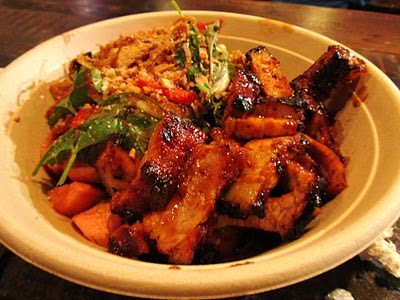
The chubby pork belly is exactly what the title says it is.  Plump, fatty, flavorful pork belly in all its juicy, lipidic glory.  Mmmmm... and all of that delicious fatty pork looks like it's sprouting from a bed of rice.  Implanted in the rice are chopped water spinach (ong choy), peanuts, and pickled watermelon radishes.  The triple combo of ong choy, peanuts, and pickled radishes in the pork belly bowl works better than the kimchi chow's triple combo of kimchi, edamame and gaenip.  The contrasting textures and flavors are more apparent, which helps maintain interest and curiosity in digging deeper into the big bowl of food.  This one... I like.  Yum.

On my first pit-stop to Chego, I picked up two items from the End section of the menu... on this pit-stop I tasted two items from the Middle section of the menu.  Perhaps the next pit-stop in Palms will yield two items from the Beginning... the ooey gooey fries and 3PM meatballs sound promising.

Until the next pit-stop, let's all get S.O.F.A.T.

ML - 20110225

Tuesday, December 28, 2010

Post 43.2: San Tung (SF: Inner Sunset)

During my visit to San Francisco over the summer, a friend introduced me to Yummy Yummy, a Chinese style Vietnamese restaurant in the Sunset District.  Right next door to Yummy Yummy is San Tung Chinese Restaurant, a restaurant that is known for its dumplings, black bean sauce noodles, and fried chicken wings.  Some of the items such as the black bean sauce noodles are prepared in a Korean style, which makes me think that the owners are ethnically Chinese but born and raised in Korea.  But I never got a chance to ask.

Naturally, my style of culinary exploration required that I order all the well-known items on the menu.  And when I asked the server what else is good at the restaurant, he replied, "Nore more! You got 'em all."  

With the help of Pei, Joanna, Larry and Jon, we ordered just a few more dishes.  Just a few.


Complementary kimchi
San Tung's kimchi is drier in that it's not submerged in a bright red pool the way that authentic Korean kimchi is.  From my numerous visits to Korean style Chinese restaurants, I've noticed that the dryness is a characteristic of kimchi made by the ethnically Chinese from Korea.  However, dry doesn't necessarily mean bland.  The kimchi has tons of kick and spice, which helps break the monotony of flavor from the black bean sauce noodles.

Pork with green onions
It's a seemingly simple dish that is actually quite complex in flavors.  It's savory from the sliced pork, sweet from the garlic and soy combination, and salty from the onions (both green and white).  Like the kimchi the wok-fired white onions provide a bite that gets addicting.  I only wish I had a bowl of rice to go with this dish.  That the rice and pork would pair well is a complete understatement.

Pork dumplings
These little fists are filled with ground pork and shredded Napa cabbage, and once dipped into some soy sauce, vinegar, and chili oil, they pack a powerful punch of savory bliss.  I like that the skin is not too thick and not too thin.  I felt like I was eating a meatball wrapped with dumpling skin rather than just simply eating dumplings.  The shrimp and leek dumplings are popular here too.


Black bean sauce noodles
I noticed that there were two black bean sauce noodles on the menu... one was listed as dry and the other was supposedly... wet? I asked the server what the difference was between the two, and he responded, "one dollar."  Okay... funny guy.  So after clarifying that monetary value was not the answer I was looking for, the server let us know that both noodles include shrimp and calamari, but the dry noodles contain scallops, and the supposed wet noodles are made with beef and a creamier sauce.  If there's an Asian version of an alfredo sauce, this is it.  Black, Asian, alfredo.  Oxymoronic? Perhaps... but it tastes good.

The group voted 4-1 in favor of the dry noodles over the wet noodles.  But I think that the beef infuses more flavor into the wet noodles, and the creamier sauce just can't be beat.  Tip from the server: mix, mix, mix until the noodles are all black... no, not yet... keep mixing!


Spinach with garlic
The simply sauteed spinach with surprisingly lengthy stems helped diversify the color of the dishes on the table... and of course it provided a healthy dose of fiber for the digestive system as well.  The larger bits of garlic dotted throughout the forest of spinach was a pleasant reminder that the garlic was most likely diced by a chef wielding a large Chinese butcher knife and not spooned in from a jar of machine-minced garlic.  No shortcuts here.  The taste makes that evident.

Dried sauteed string beans
Is this the place to get the best string beans? Eh, maybe not.  But it is a decent place to get some crunchy greens.  The flavor is a bit shallow... on the surface level.  But either a hefty helping of salt and pepper or adding ground pork to the stir-fry just might amp the flavor up just a tad.  But otherwise, you can't go wrong with a side of these veggies.

Original dry fried chicken wings
Salty, sweet, spicy, sticky, crispy, crunchy, burning hot, heartburn-inducing... ahhh... all the components of a delicious chicken wing.  From what I remember, Yummy Yummy next door has a version of the fried chicken wing as well, but the wings here seem a bit more established... less saucy, more sticky.  The ratio of chili pepper seeds to dripping honey seems to have been perfected.  These wings indicate that they have been the veteran on the block for years.  Now if only my hot tea were a Tsingtao and if the restaurant chair were a backyard hammock... oh, how happy I'd be.  I'd lap up plate after plate of chicken wings, toss the bones to the grass below, get lost in the clouds and wonder how the hell the honey gets cleaned off the plates.  Shrug... smile.

So after all these dry, not dry, and wet descriptions in the names of the dishes at San Tung, I think I've finally figured it out what they all mean.  Dry doesn't mean dry... the dish still has a decent amount of sauce.  However, dry means that it's dry compared to the wet version of the dish, which apparently indicates a substantial amount of sauce. 
Still confused? No worries, just eat.  Perhaps that's the same ideology that so many locals have adopted because many make return visits on a consistent basis.  The locals know where the good, authentic Chinese food is, and I'll give you a hint... it's not in Chinatown.

Next post: Superb Burmese

ML - 20101229/20101212

Thursday, September 30, 2010

Post 35: Finishing a Very Korean September with Gamjatang (LA: Koreatown)

Tick... pop... crack.  

As I continued to chew I wondered what was making the firecracker sensation in my mouth...

M: "What are those?"
K: "Sesame seeds."
M: "No man, they're black.  I think those are poppy seeds."
G: "Dude, my co-worker failed a drug test 'cuz she had a poppy seed bagel..."
M: "No way... that's an insignificant..."
K: "I'm telling you... they're sesame seeds"
A: "Wait.  What's wrong with poppy seeds?"
M: "Opium."
J: "What?"

The ticking, popping, and cracking black seeds were actually ground and toasted sesame seeds.  Grinding them up and toasting the seeds cause them to look round and black, allowing them to mask as poppy seeds.  They were floating around happily amongst white sesame seeds and bright green sesame seed (perilla) leaves in a deep red soup brewed from the bones of the pig's spine.  In addition to the tender, still-on-the-bone pork, the many variations of sesame seed, chunks of starchy potato were lodged at the bottom of the steel hot pot.  Hmmmm... so this is gamjatang (감자탕).


Kimmy, my token Korean friend from high school, volunteered to be our Korean food hostess for the weekend.  We call her Kimmy (her real name is Grace Kim) to highlight her Korean-ness.  Forget the fact that we have a million friends named Grace... it's her Korean-ness that allows us to call her Kimmy.  But I digress.  Kimmy, our Korean cuisine hostess extraordinaire, led us to Gam Ja Gol in Koreatown where she was about to show us some true blood Korean food... the non-BBQ, non-tofu, non-soju type of true blood Korean food.


Kimmy introduced us gamjatang, a savory stew made with the bones of a pig's spine, the earthy potatoes, and an abundance of enticing and somewhat exotic leaves of the sesame seed.  The soup was deep red.  Deep, deep red.  But it wasn't insanely spicy.  Just enough to cause droplets of perspiration to form on foreheads around the table.


In between bites of the soft pork, slurps of the savory stew, and glances at the banchan spread, I looked up every so often to ask Kimmy a question or two about the Korean food that we were having.  Gamjatang, translated literally, means potato (gamja) soup (tang), but Kimmy warned, "it's not really about the potato..."


Apparently not.  It was all about the soft and tender meat... it was about the savory and addicting soup... it was all about the fragrance of the perilla leaves... it was all about the way the gamjatang was poured into my bowl with heart, soul, and pride in the Korean culture.  It was about the complete destruction of a pig's spine... the bones looked as if they were leftover from a Velociraptor's meal.  And it was all about the second course of the meal...


As we the gamjatang slowly dwindled to its last remaining drops, the server arrived to wisp away the steel hot pot... only to refill it with white rice, chopped kimchi, and an assortment of ingredients.  I followed the sounds of the sizzle and crackle to the corner of the restaurant where it was cooking.  And as I peered into the popping pot, the server exclaimed from behind me, "chao fan!"


Bewildered, I spun around.  The supposedly Korean server used Mandarin to tell me that it was fried rice.  I didn't quite know just what to say.... or even what language to respond in.  So I just sat back down at the table, which is when Kimmy informed me, "she," pointing at the server, "told me that you looked Chinese."


I found out later that she was ethnically Korean but was born in northeastern China, so she learned to speak Mandarin growing up.  I guess that's where she learned to tell non-Koreans apart from ethnic Koreans.

But does that mean I like fried rice? Well, I sure as hell enjoyed this one.  In the little time it took to cook the fried rice, the grains of white rice had absorbed the remaining gamjatang... it was bursting with spicy and savory flavors... only a hint of which came from kimchi.  I was absolutely stuffed, and there was not a single section of spine left for us to pick at.  But I kept wanting more.  


The gamjatang rice was almost a drug.  If I had to take this drug every 8 hours for a course of 2 weeks (with food), I wouldn't have any problem with it.  In fact, I wouldn't have a problem with gamjatang or the fried rice being an intravenous drug.  Mmmm... this stuff is good.  Shoot it straight into my veins.

The gamjatang was an awesome Korean food experience.  What made it even better was that I learned and tried something I never knew existed.  Kamsamhapnida, Kimmy.  Solid meal.

Until another true blood experience, let's all get S.O.F.A.T.

ML - 201000926/20101006